
The Flagship Course
Calm and Confident
The Resiliency System for Moms
The first cohort has not opened yet. Doors open soon, and the first group will be small. Put your name on the list and you will hear before anyone else, at the founding rate.
Twelve weeks of resilient nervous system training. You learn how your own mind and body work under pressure, and how to work with them on purpose, so you can feel better when you want to.
Because a plan for your parenting only works as well as the mother running it.
The skills you need that no one ever taught you
This is resilient nervous system training
Think of it as an emotional gym. You learn how your mind and your body actually work, and then you practice using them, so you get more calm and more confidence out of the same hard days. Not just theory about your nervous system. Practice with it, for twelve weeks, until you feel confident.
Nobody ever taught you how to steady yourself first.
Everything else you have been trying to do depends on that.
How we do it
In twelve weeks, we learn how to understand and work with your body and your mind.
How you feel is what decides what you'll do. Most people try to change their behavior without ever working with the feelings underneath it. Not because they aren't trying, but because feelings can seem like a mystery. They aren't. There are science-backed ways to work with what you feel, and that is where this course starts. You learn to calm your body.
Then your thoughts. Which ones pull you down, which ones lift you up, and how to choose on purpose instead of believing whatever your mind hands you on a hard day.
Then your energy. What your own body needs to run well, and how to give it that, so you have what it takes to do the things you actually want to do.
Then your stress, from both directions. From the inside, learning to soothe your own nervous system. From the outside, choosing what you say yes to and holding the boundaries that protect you.
These skills are for everyone. But when a mother trains her own nervous system, it becomes the foundation for her parenting. And she gets to enjoy her life so much more.
That's why I call Calm and Confident the first step of resilient parenting.
Why a mother trains her nervous system
Your nervous system is not a problem to fix.
It's doing exactly what it was built to do, which is respond to what's happening. The trouble is that it can respond to a spilled cup the way it would respond to real danger, and nobody ever showed you what to do while that is happening.
Resilience is not being calm all the time.
It's being able to ride the ups and downs instead of being thrown by them. Life is a rollercoaster and it doesn't stop being one. What changes is whether you have something to hold onto on the way down.
Once you can calm your body on that rollercoaster, everything changes.
You stop being afraid of your own reactions.
A hard feeling shows up, and you know what it is and what to do with it.
A pesky thought shows up, and you don't have to believe it.
And the stress that used to make your decisions for you stops getting a vote.
Why it's called Calm and Confident
Calm is what these skills bring into your nervous system, and then into the rest of your life.
Confident is knowing that whatever shows up, a feeling, a thought, a hard day, you get to choose what you do with it.
The framework
The Resiliency System
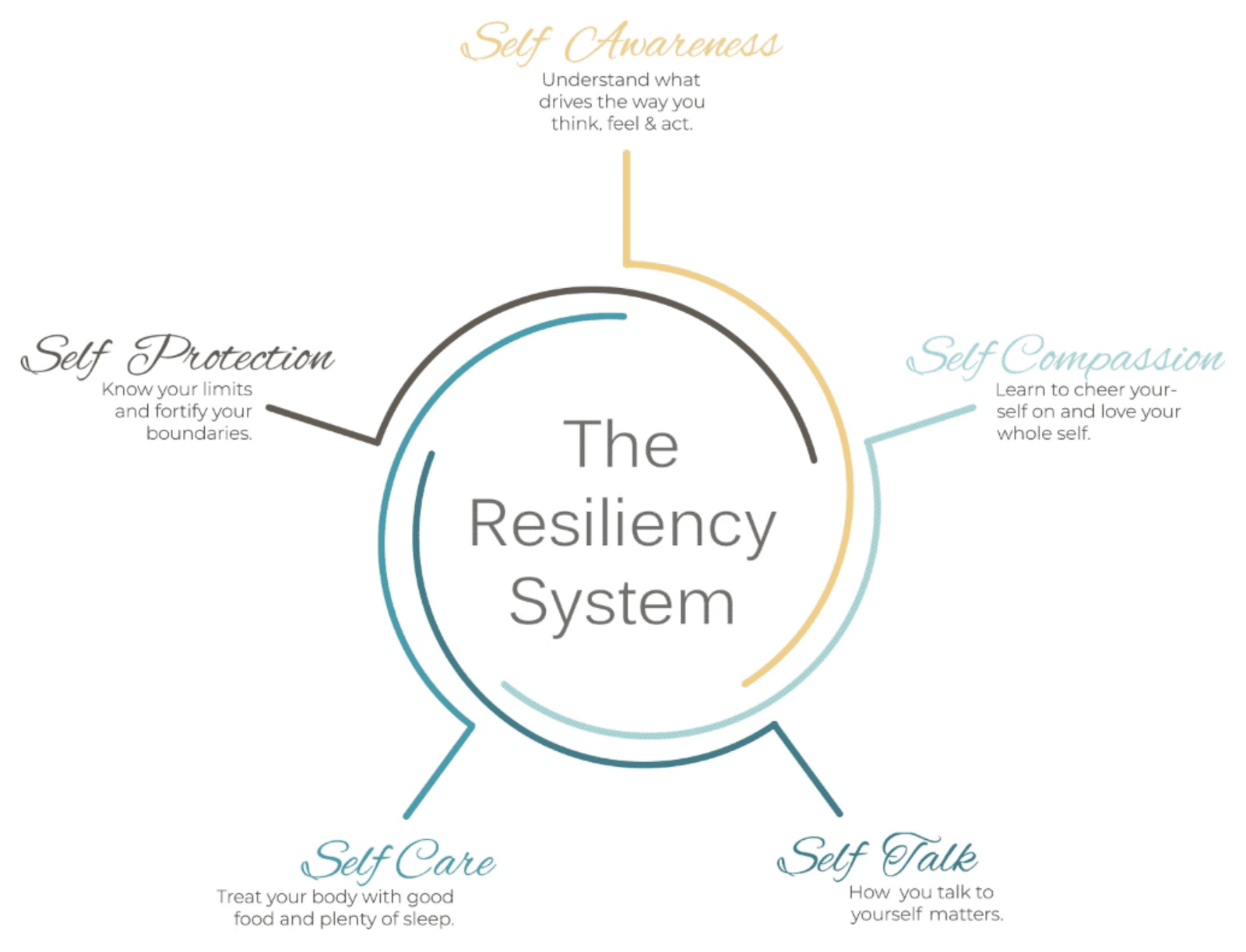
Five skills that train your nervous system. Nothing here is about fixing something broken in you. The steadiness is already there. These are the skills that get you back to it on the days it feels far away.
Inside the system
The five pillars, one at a time
Pillar One
Self-Awareness
Understand what drives the way you think, feel, and act.
Noticing what is happening inside you, in your body, your thoughts, your emotions, your impulses, without immediately reacting to it.
The key idea. You cannot work with what you cannot see. Awareness creates the pause. The pause creates choice.
Pillar Two
Self-Talk
How you talk to yourself matters.
Directing your inner voice on purpose. Thoughts are mental events, not facts. You can learn to notice them, weigh them, and choose differently.
The key idea. The story your mind tells you about what is happening shapes how you feel and what you do. You have more influence over that story than you know.
Pillar Three
Self-Compassion
Cheer yourself on and love your whole self.
Responding to your own struggle with the same kindness you would offer a friend. Not skipping past the hard thing, but meeting it with gentleness instead of criticism.
The key idea. Compassion creates safety, and safety is what lets you see clearly enough to change something. Criticism skips all of that and goes straight to shame.
Pillar Four
Self-Care
Treat your body with good food and plenty of sleep.
Not bubble baths. This is what your body actually needs to function, because your nervous system runs on sleep, food, and movement. Not enough of these will undermine all of your other efforts.
The key idea. A tired, underfed nervous system cannot settle itself no matter how much you know. This is the physical half of the work, and it is not optional.
Pillar Five
Self-Protection
Handle stress from the inside and from the outside.
Working with stress in both directions. From the inside, soothing your own nervous system once it is already going. From the outside, choosing what you take on and setting the boundaries that keep you from being worn down in the first place.
The key idea. Stress is information, not a personal failing. Once you can read it and answer it, in your body and in your schedule, stress stops making your decisions for you.
How they hold each other up
One strong pillar makes the next one possible
When Self-Awareness is strong, you catch what is happening before it takes over. You create a pause between the trigger and the response.
When Self-Talk is strong, you can aim that pause at a thought that is actually true and useful, instead of a story that escalates everything.
When Self-Compassion is strong, you can make a mistake and recover without the shame spiral. You can repair with your kids because you can repair with yourself.
When Self-Care is strong, your nervous system has what it needs. You are not running on empty trying to give from what isn't there.
When Self-Protection is strong, you see the warning signs before you hit the wall. You know what depletes you and what restores you, and you choose accordingly.
The goal is not to eliminate stress or difficulty.
The goal is to have a way back to yourself, no matter what life brings.
What twelve weeks does
What's different at the end of our time together
You catch it sooner. There is a pause between what happens and what you do about it, and that pause is where every other choice lives.
You recover faster. A hard twenty minutes stops taking the whole day with it, and you can go back and repair without carrying it for a week.
Your body settles. You are not running at low-grade stress all day waiting for the next thing to go wrong.
You know what to do with a hard feeling instead of pushing it down or being run by it.
The critic in your head gets quieter, and you stop paying for one bad moment for days afterward.
Your family feels it before you say a word about it. Not because you taught them anything, but because the person they live with is steadier.
None of this makes you a calmer person by personality. It's training, the same way strength is training. You practice it on the ordinary days so it's there on the hard ones, and after twelve weeks it's not something you're trying to remember. It's just how you handle things.
Three ways to learn these skills
The cohort is the way most moms do this, and it is the one opening first. Same twelve weeks, same system, either way. What changes is how much support you get as you learn.
On your own
Opening soon
Every module and every workbook, at whatever pace your life allows. Yours to keep and come back to.
What's good about it
It's an affordable way to get the calm and confidence you need for your personal happiness and your parenting success. Nothing is scheduled, so nothing conflicts with your week.
What to know
There's nobody to ask when you get stuck, and self-paced has a way of turning into not yet, which is the real risk of doing anything alone.
If this is your preference, the Resilient Mom Membership opens soon and will give you extra support on a weekly call with me.
Where most moms start
The Cohort
First cohort opening soon. Join the waitlist below
Everything in self-study, plus a weekly live call with me and a small group of mothers doing the same work in the same weeks. You watch the module, then we spend the call applying it to your actual life.
What's good about it
The group stays small enough that there's time for your questions. You learn as much from the other mothers as you do from me, and you have a dedicated space protected in your schedule to spend time on you and your wellness.
What to know
You get time on the call to ask your questions and work out how to apply things at home. If you want a full hour that's only about your situation, your children, and your own goals, one to one personal resilience coaching is the better fit.
Can't make a session? Every call is recorded.
Just us
Open now
You get the recorded course, and we step through it together. Your goals, your children, and support shaped around exactly what your family needs.
What's good about it
Nothing is general. Every hour is about you, and we can go wherever the work needs to go, including the parenting questions the group format cannot hold.
What to know
There are limited spots on my calendar.
Schedule a consult call to see if personal resilience coaching is the right fit for you.
The course and the membership are built to work together
If you are already in the Resilient Mom Membership, this course goes deeper. It builds the foundation underneath everything you are seeing there, so the workshops and the calls make sense in a way they could not before.
And when the twelve weeks are over, the membership is where you keep practicing it, week after week, with me. Most moms find that doing both the course and the membership helps them deeply integrate the skills and keep getting support and new ideas.
When the membership opens, members will hear about each cohort first and pay less for the course.
Before you decide
Is this for you?
Yes, if
You are the one holding it all together and there is nothing left over for you.
You have tried techniques and they stop working the moment you're upset.
You want something to change in you, not one more strategy for your child.
You are willing to practice something rather than just learn about it.
Not yet, if
What you want right now is quick behavior fixes for your child.
You want the focus to stay on your child rather than on you.
You can't give it about an hour a week for twelve weeks.
The Resilient Mom Membership opens soon and will be the more flexible option, with a weekly live call with me for a lot less. Get on this list and I'll tell you when.
You're carrying something heavy enough that a group can't hold it.
You might want to consider one to one personal resilience coaching instead.
What you need right now is treatment for a mood disorder, or care for trauma. Those needs are best served by therapy. This course is education and training, and it is not therapy.
Who built it
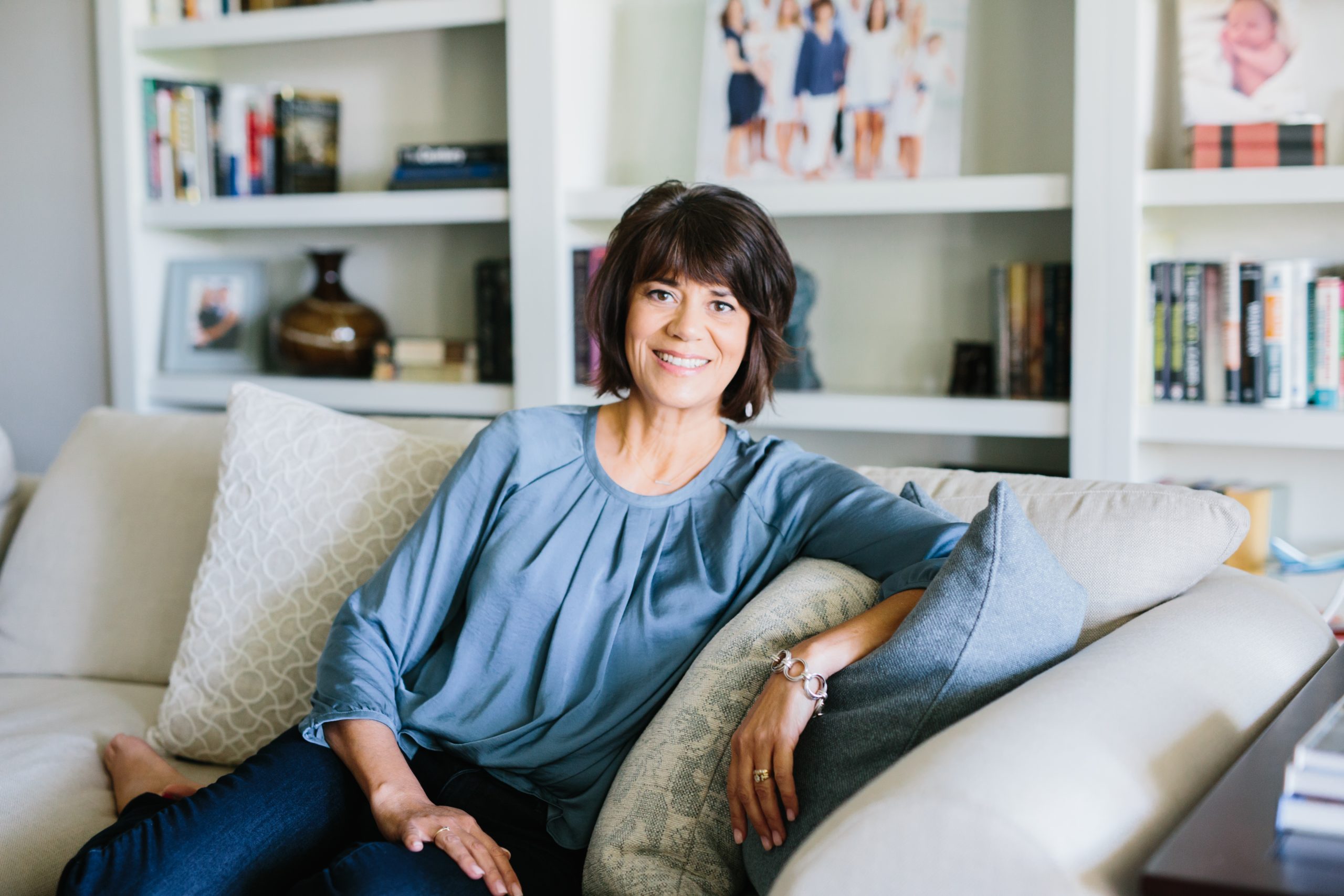
I'm a therapist and a mom of five.
For more than 30 years I've helped women and families become calmer and more sure of themselves. Thousands of mothers, hundreds of families. Along the way I did advanced training in positive psychology and in how the nervous system behaves under pressure.
The Resiliency System came out of all of it. Not a set of tips I gathered, but a methodology I built, and Calm and Confident is that system taught in order, one pillar at a time.
Seeing moms feel stronger and more confident in their parenting is why I do this work. I never get tired of it, because it doesn't stop with them. It creates calmer homes, and kids who grow up resilient.
Be first in line
Join the waitlist for the first cohort
This list is for the live twelve-week cohort, the group that goes through the Calm and Confident curriculum with me. The self-study version opens at the same time, and you will hear about both. Working one to one is already open, so you do not need this list for that.
What being on the list gets you
No spam, and no pressure when it opens. You can leave the list any time.
While you wait, help yourself to the Free Podcast Library. Every episode I've recorded, sorted by what you're actually dealing with, so the one you need today is easy to find. It's free.